
Digital Time Travel: Two Heritage Projects Selected for the 3DBigDataSpace Outreach Call
The Time Machine Organisation (TMO), acting as the coordinator for the European Union co-funded 3DBigDataSpace project, has selected two innovative heritage initiatives to receive €10,000 subcontracts each to develop engaging applications for public outreach. The 3DBigDataSpace project is designed to prototype long-term, Europe-wide storage for 3D cultural heritage assets, enhancing how this content is found and reused through 4D applications and augmented reality. These two winning projects were chosen for their ability to design innovative applications that use the 3DBigDataSpace tools to engage a broad public audience.
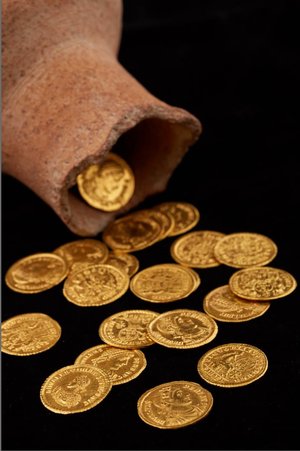
Golden Bond project credit : Erimtan Archaeology and Arts Museum Archive
The Golden Bond: Unfolding the Kapulukaya Hoard
The project “The Golden Bond: Unfolding the Kapulukaya Hoard” focuses on the Kapulukaya Solidus Hoard, which consists of 21 Roman gold coins and the terracotta vessel in which they were discovered. To bridge the gap between static museum displays and deep historical understanding, the team uses the PCSS Viewer to present 3D coin models that visitors can manipulate via touch gestures to inspect fine surface details. The 4D Viewer further enriches the experience by tracing the historical route of the coins between Antioch and Ancyra on an interactive map. Additionally, Rooom XR provides a mobile augmented reality experience, allowing visitors to scan a QR code and project a unique solidus directly into their own surroundings. By employing a concept termed "semantic storytelling origami," the project uses spatial computing to unfold dense historical information from a single coin.
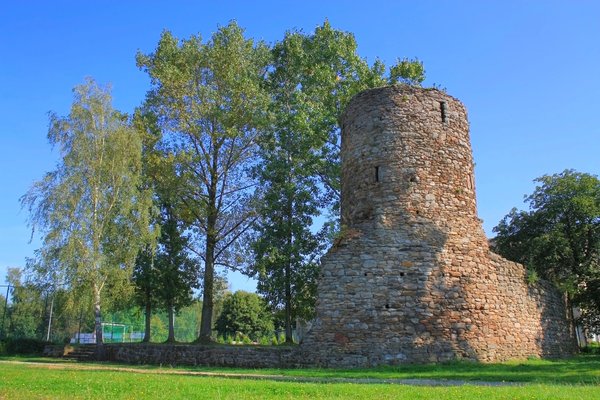
The remains of the moated castle of Ruppendorf today. Credit: Mario Hehne
In the Eastern Ore Mountains, the moated castle of Ruppendorf serves as the central site for a project aimed at preserving over 60 years of local chronicle work before it is irretrievably lost. The initiative builds upon the extensive voluntary research of the AG Ortschronik Ruppendorf, whose members have collected and documented deeds, maps, photographs, drawings, and oral histories related to the village and its castle for decades.
The application uses the PCSS Viewer for detailed 3D visualisations and the 4D Browser for spatio-temporal navigation. Visitors will be able to explore a sequence of historical time slices covering the period from approximately 1500 to 2024, based on current 3D reconstructions of the castle complex.
The year 1349, the first documented mention of the castle, is presented within the application as a historical source but does not yet form its own reconstructed 3D model. As research progresses, earlier reconstruction phases may be integrated in future iterations.
A key feature is the digital opening of the castle tower's hidden interior, which has been inaccessible for decades, through 360° panoramas and 3D reconstructions. The project prioritizes scientific transparency by visually distinguishing between original masonry and interpreted reconstructions, while also assigning "evidence grades" to every reconstructed element. On-site visitors can access the "Digital Museum Ruppendorf" by scanning a QR code on a weatherproof panel to begin a gamified "Explorer Mode" or a deep-dive "Time Machine Mode".
The project is led by Mario Hehne, Project Lead, Co-founder of Apus Systems, Chair of the Local Advisory Council of Ruppendorf, and Head of the AG Ortschronik Ruppendorf, whose long-term commitment to documenting the village’s history laid the foundation for the digital initiative.
