
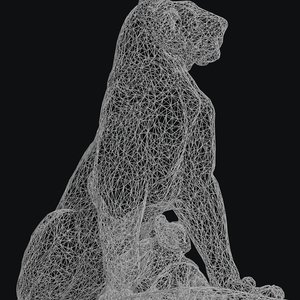
This text is being prepared as part of the collaboration between CARARE and Pixelated Realities, partners in the XRculture consortium, to highlight how Ukrainian heritage professionals are documenting culture under wartime conditions. Pixelated Realities is a non‑profit organisation from Odessa, Ukraine, dedicated to improving cultural heritage preservation through 3D scanning, photogrammetry and digital production. Building on years of work developing best practices for digital documentation, the team is n
2022: A Scan Under Wartime Conditions
When Russia's full-scale invasion of Ukraine began in February 2022, the Odesa-based non-profit Pixelated Realities mobilised to document in 3D the city's most treasured heritage objects before they could be damaged or destroyed. On 11 August 2022, a team of photogrammetry specialists set out to capture the Lion and Lioness in full three-dimensional detail.
The mission was far from straightforward. The scanning location in Odesa, the City Garden, is situated on a pedestrian street. To take photos on the street, one would also need approval from the city's military administration. To reach the upper sections of the sculptures, the team needed scaffolding or an autocrane. Rather than sourcing industrial equipment, the operators found a creative solution: a nearby museum of local lore voluntarily lent its staircases. Every day, the operators carried those stairs by hand to the scanning site and positioned them precisely around the sculptures to capture every angle.
The method used was emergency photogrammetry, a process of taking hundreds of photographs from multiple angles and processing them with specialised software to reconstruct a precise, photorealistic 3D model. This technique captures not only the form of an object but also its surface texture, color, and materiality in extraordinary detail.
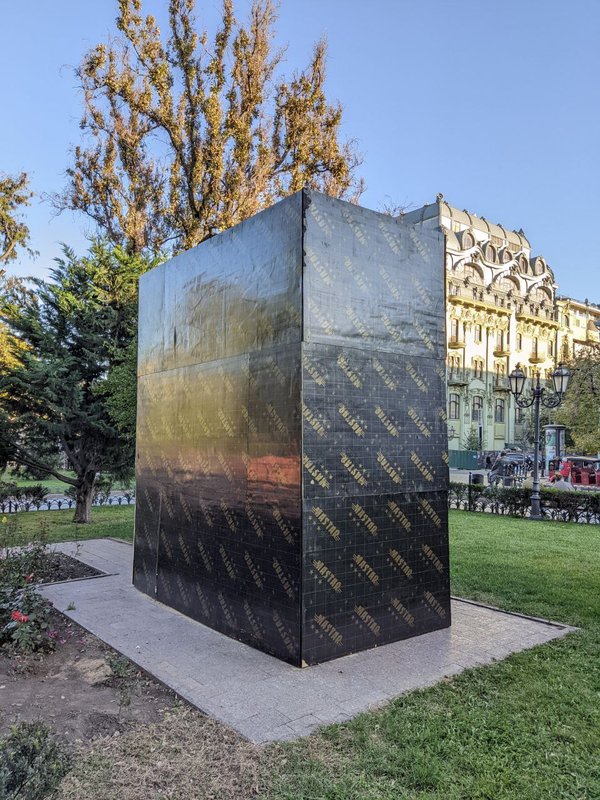
The Lioness of Odessa protected for the war ©Pixelated Realities
Background: Icons of a City
The sculptural group “Lion and Lioness” was created in 1854 by the French animalier sculptor Auguste Caïn (Caen) and originally shown at the Paris Salon, where it was acquired by a wealthy resident of Odesa. Until the 1920s, the bronzes adorned the private gardens of merchants, cultural figures and entrepreneurs, before being nationalised in 1927 and installed at the entrance to the Odesa City Garden. Restoration works revealed that the statues are cast from almost pure copper (99.7%) and weigh around 1.5 tonnes each. Today, the Lion and Lioness are regarded as one of the most beloved sculptural landmarks of Odesa’s historic centre, with the lion symbolising courage and bravery and the lioness maternal care.
Background: Icons of a City
The sculptural group “Lion and Lioness” was created in 1854 by the French animalier sculptor Auguste Caïn (Caen) and originally shown at the Paris Salon, where it was acquired by a wealthy resident of Odesa. Until the 1920s, the bronzes adorned the private gardens of merchants, cultural figures and entrepreneurs, before being nationalised in 1927 and installed at the entrance to the Odesa City Garden. Restoration works revealed that the statues are cast from almost pure copper (99.7%) and weigh around 1.5 tonnes each. Today, the Lion and Lioness are regarded as one of the most beloved sculptural landmarks of Odesa’s historic centre, with the lion symbolising courage and bravery and the lioness maternal care.
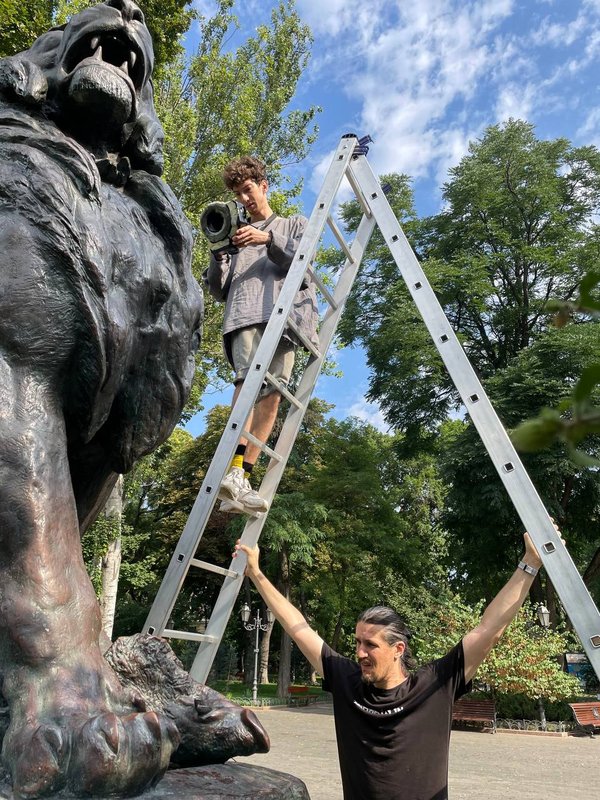
The digitisation process in Odessa ©Pixelated Realities
Preservation in Time
Just two months after the scan was completed, in October 2022, the Lions, along with a number of other Odesa sculptures, were encased in protective structures as part of the Museum for Change initiative, supported by UNESCO. The structures consist of metal frames, fillings, and casings designed to shield the bronze from shelling and blast waves.
Today, the Lion and Lioness remain sealed inside their protective casings. They cannot be approached or viewed up close. The only way to see them in their full detail is online, and on Europeana.
This is what makes the August 2022 scan so significant: it preserves a moment in time just before the sculptures disappeared from public view, creating a digital record that anyone, anywhere in the world, can now access.
From Odesa to Europeana
The 3D models of the Lion and Lioness of the Odesa City Garden are now publicly available on Europeana, Europe's flagship digital platform for cultural heritage, hosting over 50 million items from more than 3,500 institutions across the continent.
Their publication is part of a wider milestone: the first-ever Ukrainian 3D cultural heritage models to be published on Europeana. The collection, created under the Museum of Ukrainian Victory (MOUV) initiative, also includes the Statue of Duke de Richelieu in Odesa, the Taras Shevchenko monuments in Odesa and Kharkiv, the Polovtsian warrior statues from the Kharkiv region, the Northern Gate of Kherson Fortress, and the Okhtyrka City Museum in the Sumy region.
This achievement was made possible through Pixelated Realities' collaboration with the EU-funded XRculture and 3D-4CH Online Competence Centre projects, which develop technical workflows for aggregating, optimising, and sharing 3D cultural heritage data across open-access platforms.
Why it Matters
These 3D models are more than digital copies; they are acts of resistance and resilience. Founded in 2016 in Odesa, Pixelated Realities began its work out of a premonition: in 2015, its founders scanned the Statue of Duke de Richelieu because they feared it might one day be lost to war. That fear became reality for countless heritage sites across Ukraine. The Lions of Odesa, for now, are safe, but their digital copies ensure that no matter what happens, these symbols of courage and care will endure.
